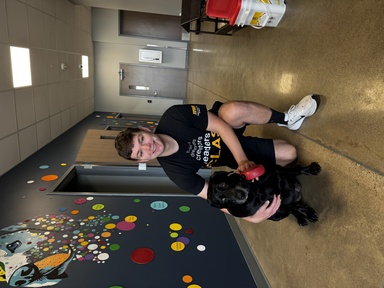
Rising sophomore Jered Kerr has followed his academic instincts and career aspirations to benefit the community neighboring his hometown. With support from a grant received from the Office of Community Engagement, he partnered with the PAW Fort Madison Animal Shelter to deliver new outdoor fencing and promotional flyers to the nonprofit.
Upon arriving at the University of Iowa his freshman year, Kerr took several classes for his journalism major and discovered a passion for working with nonprofits. In his first-year seminar, Beyond Volunteering, he was nudged toward taking another class centered around nonprofit volunteering for his second semester that ultimately introduced him to the grant opportunity.
Around eight years ago, Kerr’s family adopted a dog from the shelter: a three-year-old lab with a sleek black coat named Briar. Kerr explained that this connection with the shelter opened the door to his future collaboration with them. “I knew the director pretty well, so I asked if I could start volunteering there. Then, once I got more involved with it, I asked if she would be okay with doing this project, and she said, ‘That would be great.’”
The shelter’s mission is to find every animal inside the building a loving family to spend the rest of their days with and provide animal welfare for that area, and with the help of the grant and Kerr’s passion for the animals, this mission was undoubtedly honored.
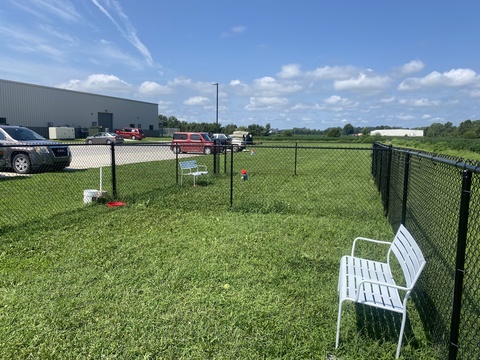
Kerr’s project took place in two stages. The first dealt with building the fence that divided two outdoor play areas. The main objective of the area was to create a safe space to introduce dogs to one another. For example, if a family already had a dog but wanted to adopt another from the shelter, the two could acclimate in a safe, controlled environment. They would start by sniffing through the fence and then slowly be brought together.
“The most rewarding part,” said Kerr, “was seeing the dogs play outside. They played well together, and they just seemed so excited to get out and play with each other.”
The second stage dealt with promoting the shelter itself. Kerr worked to design a poster that promoted several different aspects of what the shelter had to offer, including can drives, adoption programs, clubs, and events. He wanted to get the community engaged with and connected to the hard work the shelter does.
“I’m hoping that at least one person will see the flyer and think, ‘Hey, I could go volunteer here for a couple of hours a week.’ Any help really does make a difference.”
The project challenged and developed Kerr’s problem-solving abilities in real-world situations, guiding him to be quick on his feet to address challenges as they arose.
“Don’t worry about the setbacks,” Kerr advised other students interested in this line of work. “Life happens. Don’t worry about the little things.”
The smaller scale of the project also made it feel less daunting, while still contributing to a worthwhile impact, Kerr noted. Smaller grants like this and their associated projects are good starting points for students looking to get involved at an accessible level.
“It was a great experience,” he added. “I would do it again for sure.”
You can hear more about Jared's experience here.