If you think getting a journalism degree prepares you only for a career in a newsroom, you’re in for a surprise.
The skills you gain from a journalism degree program are applicable to many careers — from print journalism to broadcasting, communications positions to social media storytelling, public relations to event planning, and content marketing to nonprofit work.
“Journalism students go out and do everything that you could imagine,” says Melissa Tully, director of the University of Iowa School of Journalism and Mass Communication. “We still have students who want to go into more traditional news and journalism, but we also have students who want to go work for organizations such as nonprofits or government agencies or sports teams.
“A journalism degree trains students to be adaptable. Between day one of class and when they leave four years later, there will be jobs that exist that didn’t exist when they started. Students can go anywhere with the skills that they gain from a journalism and mass communication program.”
Brandee Britt, who graduated from the University of Iowa in 2015 with BAs in journalism and mass communication and sports studies, says she is an example of this.
"I work in social media and digital media, which existed when I was in college, but nowhere near the way that it exists right now," says the director of social media and digital strategy for University of Iowa Athletics. "The job I’m in now didn’t exist when I started college, didn’t exist when I graduated, didn’t exist up until two years ago. It’s pretty cool how that has transformed.”
Is journalism a useful degree?
Journalism is a broad area of study that teaches skills valuable to many fields. For example, the ability to find, organize, and effectively communicate complex information — core skills for many types of journalism — is critical to many careers.
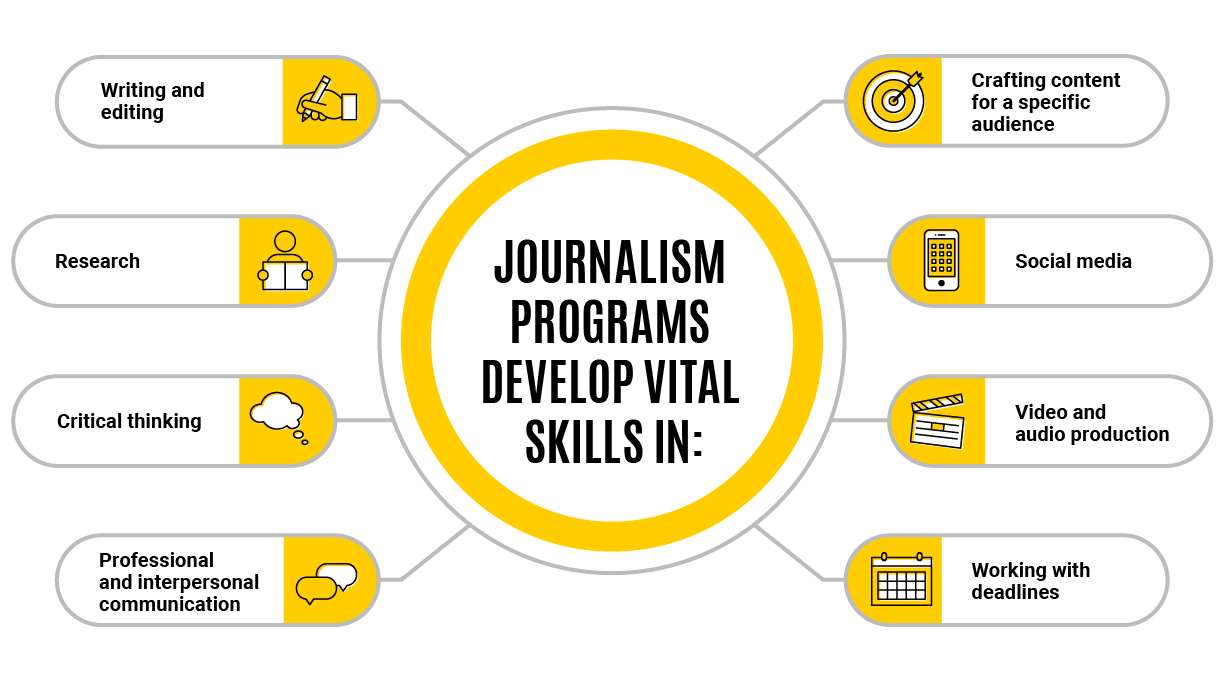
“When we talk to our alumni, lots of them have worked as journalists or traditional reporters, and some of them go on to do something else,” Tully says. “The skills that you develop in a journalism program can take you on various career paths. You may find your passion changes over time, and that’s OK because you’ve developed a foundational skill set that allows you to do several kinds of in-demand jobs.”
Hawkeye perspectives
"People I went to school with are now working at local and national news outlets. Others are working in public relations and communications. One of my classmates is working in the field of politics. There are many different things you can do with the skills that you gain in a journalism program."
“Being a journalist requires you to be a jack-of-all-trades. There are many skills you’ll find yourself needing. Tech literacy is a huge one; a lot of reporting these days is knowing how to find the information that you need online. Multimedia skills – because even if it’s not your primary job, you may need to take photos or video. Know how to use Excel, even if you’re not specifically responsible for working with data. Graphic skills also can be really useful. There may be some journalists who can get away without knowing a little about all these things, but that hasn't been the case for me.”
Where can you go with a journalism degree?
A journalism degree can take you down many varied professional paths. Career opportunities in journalism can take you around the world, introduce you to new people, and provide the chance to do meaningful work.
“The field of journalism and media is constantly evolving,” Tully says. “It’s important that you have a sense of adventure and willingness to experiment with the many opportunities that are going to become available.”
Potential jobs for journalism majors can include:
- Editor at a publishing house
- Content writer or blogger
- Technical writer
- Digital or content marketer
- Public relations specialist/manager
- Market research analyst
- User experience research and design
- Social media specialist/manager
- Event planner
- Fundraiser
- Development director
- Video producer
- Podcaster
- Advertising creative director
What is the highest-paid journalism job?
The literal answer to this would involve name-dropping of famous faces. The annual salaries of many well-known broadcasters — including journalism and mass communication grads such as David Muir, Robin Roberts, and Stephen A. Smith — are purported to be large enough to necessitate two commas.
While it’s good to have lofty goals, it might not be best to hold up outliers as the definition of a journalism degree salary.
There are different professions to consider within the various types of journalism, and you might want an answer that looks beyond traditional journalism and encompasses various occupations that can be attained with a journalism degree.
Below you’ll find salary ranges for jobs commonly pursued by journalism majors. While traditional roles like reporters, editors, photographers, and proofreaders are well represented, the data highlights something many students may not expect: a journalism degree opens doors far beyond the newsroom. Today’s programs focus on versatile, in-demand skills — writing, research, storytelling, digital media, and strategic communication — that prepare graduates for a wide range of careers, including public relations, mass communication, fundraising, and digital communication roles across many industries.
The average annual salary is there, but we also want to show what an income looks like at various percentiles (10th, 50th, and 90th). The lower points give you an idea of where entry-level jobs might land, or what you might be paid in certain geographic regions that aren’t major media markets. (It’s not impossible to make six figures right out of college, but it’s hardly common.)
Salaries for Journalism Jobs
| TITLE | US AVERAGE | 10TH % | 50TH % | 90TH % |
|---|---|---|---|---|
| News analysts, reporters, and journalists | $106,030 | $34,590 | $60,280 | $162,430 |
| Writers and authors | $85,780 | $41,080 | $72,270 | $133,680 |
| Proofreaders and copy markers | $52,730 | $33,530 | $49,210 | $78,040 |
| Editors | $85,700 | $36,200 | $75,260 | $140,840 |
| News and digital producers / broadcast news producers | $114,280 | $43,060 | $83,480 | $198,530 |
| Radio and podcast hosts/anchors | $80,110 | $26,000 | $45,680 | $131,780 |
| Film and video editors | $83,530 | $39,170 | $70,980 | $145,900 |
| Photojournalists | $55,650 | $29,610 | $45,520 | $94,760 |
Salaries for Media and Mass Communication Jobs
| TITLE | US AVERAGE | 10TH % | 50TH % | 90TH % |
|---|---|---|---|---|
| Public relations managers | $163,520 | $78,880 | $138,520 | NA |
| Public relations specialists | $80,310 | $40,750 | $69,780 | $129,480 |
| Digital content manager, social media manager, or digital communication strategist | $149,890 | $68,860 | $149,890 | $227,590 |
| Advertising and promotions managers | $149,270 | $63,000 | $126,960 | NA |
NA = Not provided in dataset. Source: U.S. Bureau of Labor Statistics, May 2024
Certain positions in digital communication, public relations, and advertising might bump you up a tax bracket, especially at the management level. Advertising managers and public relations managers see average salaries around $150K, for example; digital communication managers are not far behind that mark.
In terms of traditional journalism jobs, the average salary data above points to news analysts/reporters/journalists as the most lucrative job category — but this comes with a caveat. While that category sees an average salary over $100K, it’s worth noting that the median average salary — the dollar amount at which there is an equal number of people earning more and less than that — is closer to $60K. That would indicate that the top earners in the category are seriously skewing the average salary figure.
Is it hard to get a job with a journalism degree?
Average salary figures don’t mean a lot to aspiring journalists who can’t find work. So, are there jobs out there?
There is demand for people who hold a journalism degree, both in traditional journalism settings and in fields that crave critical thinkers who can communicate. This is true whether you’re seeking an entry-level journalism job or a seasoned pro looking for your next challenge.
There were hundreds, if not thousands, of postings for jobs in the United States across many types of journalism and related fields, and forecasts from the U.S. Bureau of Labor Statistics for the next 10 years look strong for many disciplines.
Traditional journalism and mass communication jobs, however, are projected to decline over the next few years, anywhere from 3% to 4%. That said, average annual openings certainly won’t run dry. The projected employment growth for digital communication, public relations, advertising, fundraising/development, and most broadcast fields is more positive.
Projected growth of journalism and mass communication jobs
Not all growth is created equal. The job postings stat below shows the relative size of each job category. For example, a 10% growth rate in film and video editors would equate to 366 job postings. But that same growth rate in a much bigger job, like public relations specialists, would result in over 10K job postings.
Growing journalism and mass communication jobs
| Title | Projected Growth Through 2034 | Job Postings in Past 12 Months |
|---|---|---|
| Public relations managers | 5.0% | 11,199 |
| News and digital producers / broadcast news producers | 4.9% | 14,212 |
| Public relations specialists | 4.8% | 101,579 |
| Digital content manager, social media manager, digital communication strategist | 4.5% | 52,173 |
| Health education specialists | 4.5% | 3,097 |
| Film and video editors | 4.0% | 3,660 |
| Writers and authors | 3.6% | 18,701 |
| Photojournalists | 1.8% | 10,886 |
| Technical writers | 0.9% | 19,641 |
| Editors | 0.6% | 10,644 |
Declining jobs in journalism and mass communication
| Title | Projected Growth Through 2034 | Job Postings in Past 12 Months |
|---|---|---|
| Radio and podcast hosts/anchors | -5.5% | 14,212 |
| News analysts, reporters, and journalists | -3.9% | 7,754 |
| Advertising and promotions managers | -2.2% | 1,243 |
| Proofreaders and copymarkers | -0.6% | 509 |
(Sources: Job posting data from Chmura/JobsEQ; projected employment growth and average annual openings from U.S. Bureau of Labor Statistics, 2024)
OK, so how does one stand out in an applicant pool?
The skills of a journalist fall into two categories: hard skills and soft skills. In terms of hard skills, employers want to know if you can use software and technology specific to the position. Do you know your way around Microsoft Office (or other brands’ equivalents)? Do you understand trends in social media? Are you proficient in audio and/or video editing?
And don’t sleep on soft skills — hiring managers want people with outstanding communication skills, the ability to prioritize/manage their time, people who work well in teams ... and did we mention outstanding communication skills? The ability to communicate is vital to any industry, not just journalism/mass communication.
“The flexibility of a journalism degree and the ability to develop skills that will stay with you even as industries change — that’s incredibly valuable,” says Tully. “The journalism degree experience will serve graduates well at their first job, their second job, and the rest of their lives.”
Communication matters. Your future boss says so.
When employers were asked to rate* the importance of career-readiness competencies, communication ranked the highest:
- Communication: 4.55
- Teamwork: 4.49
- Critical thinking: 4.48
- Professionalism: 4.25
- Equity and inclusion: 4.22
- Technology: 3.98
- Career and self-development: 3.83
- Leadership: 3.60
* — 5-point scale, where 1=Not at all important, 2=Not very important, 3=Somewhat important, 4=Very important, and 5=Extremely important
Source: National Association of Colleges and Employers (NACE) Job Outlook 2024
Related content
Are journalism degrees worth it?

Can you make a living off journalism?