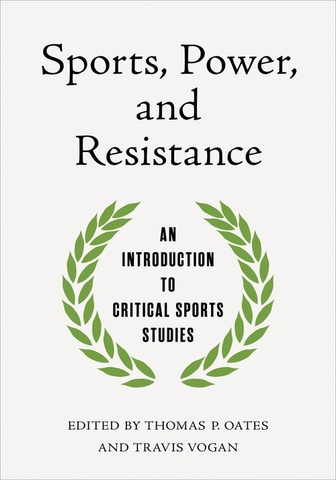
Sports are more than just scores and championships. They are sites of struggle regarding identity, politics, and social change. Professors Thomas Oates and Travis Vogan set out to examine these intersections in their newly published book, "Sports, Power, and Resistance: An Introduction to Critical Sports Studies." The book features a collection of essays organized into three parts: Imagining Belonging, Athletes and Resistance, and Political Activism.
The exigence for the project began with an uptick in athlete activism in the 2020s but was set into motion with the Obermann Arts and Humanities Symposium in 2023.
"We wanted to provide a venue for those people who were studying the same basic topic but doing so from different points of view in different areas to have a dialogue. And we used the theme Sports, Power, and Resistance as the occasion for that conversation," said Vogan.
Individuals from a number of disciplines with interest in the same kinds of questions that motivated the symposium were invited with the understanding that they would be contributing a chapter to a collection. They were given relatively free reign to decide what they wanted to look into, and it was then Oates and Vogan's role to organize and connect the different threads into the various parts of the book.
Critical sports studies consist of looking at the infrastructure around elite sports in the United States and globally, with an eye to understanding how they uphold or challenge systems of power.
"At the most basic level, sports are these activities that bring people together, and whenever you bring people together, you have not just activities that are happening, but values and beliefs that are intersecting as well," explained Vogan.
Sports thus become places to wrestle with some of these attitudes, whether it's regional identity, race, or gender. Sports are such a big part of culture that they inevitably speak to all the different complexities and nuances that mark culture, and that culture is then reflected in politics.
All sports are political. There is no way to stage commercialized sports for an audience of millions of people without politics being involved somehow. And those aren't necessarily partisan or electoral politics, although they can be.
"Where politics are most potent, is when most people agree," said Oates. "When politics are about things that don't even look like politics, that doesn't mean politics aren't present."
A lot of people talk about keeping politics out of sports. Oates says that ship sailed the second we started caring.
"We have to have politics in sports, because we care about sports, and we make meaning out of sports."
To be a responsible citizen, viewer, or journalist, it's important to understand that politics are a part of meaning making and meaning making as a part of sports.
Media is the first line of meaning making. They direct our attention to certain kinds of sports, they tell us what's happening, they tell us why it matters, and they tell us the significance.
Media has a responsibility to showcase the diversity and complexity of sports.
"I think sports media could do a better job trying to give people a fuller picture of what sports are, who plays them, and why they matter," said Vogan.
Resistance is highlighted by the media, and while some instances are highly visible, there's lots of little ways in which athletes and fans exercise resistance through the consumption and promotion of sports that go uncovered.
"Just because power is present, does not mean that resistance is impossible. Resistance is always present where power is present. And if we can't find it, it's because we're not looking carefully enough," concluded Oates.
Don't take sports for granted as something that doesn't matter. "If we pay close attention to what's going on in sports, we can learn an awful lot about the world," said Vogan.