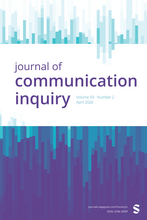
The Journal of Communication Inquiry (JCI), one of the only scholarly journals in the United States edited by graduate students, celebrated its 50th anniversary in 2024 and has continued to publish leading critical research in media studies.
One of the first American journals to release work in media and cultural studies when it launched in 1974, JCI has published numerous trailblazers within its realm of scholarship. One such up-and-coming is Dr. Javie Ssozi, recent PhD graduate from the SJMC's Mass Communication program.
Ssozi currently serves as the managing editor of JCI under the leadership of David Dowling, who holds the title of executive editor. During his doctorate career, Ssozi has helped JCI continue to blossom, and he is thrilled that it has continued to attract students and professionals alike.
“Unlike other journals, where you have a number of people who are running it and people who are working full-time with way more resources, JCI has been designed to be run by students in the program and to make the most of their decisions [regarding the journal],” he said.
Similar to some other academic journals, JCI uses a double-blind peer-review process, meaning that reviewers who are experts in the subject matter review the submission without knowing who the authors are and the authors do not know who the reviewers are. According to Ssozi, this gives authors a more equal and fair chance and reduces biases from reviewers.
Ssozi has edited as well as published articles in JCI, including a March article on reimagining gender representation on social media. Contributions come from scholars at a variety of universities in the United States and around the world, providing a forum for people to learn about the intersection of media and culture.
Ssozi has further developed his own research agenda through his work with JCI, primarily studying how social media companies are governed and the conflicts that can arise from said governance.
“Governments feel that they need to have more control over how these [social media] companies work,” he explained. “On the other hand, those platform companies feel that they should have more freedom. They’re basically telling people that ‘we’re giving you a platform and you choose how you want to use it.’”
Dowling expressed pride in how much JCI has evolved, combining topics such as political economy, postcolonial critique, and feminist media studies to be a journal that supports scholars and article subjects from various cultural and intersectional backgrounds. He emphasized how important an academic journal can be to defend democratic practices and different perspectives, especially during the current geopolitical situation.
“We now find ourselves at a moment marked by profound political, technological, and cultural transformation,” Dowling said. “From the erosion of democratic norms and the rise of algorithmic governance to the continued consolidation of media ownership and the amplification of racialized, gendered, and class-based inequalities—we are living through a time that demands robust, critical frameworks for understanding how power operates through media."
To celebrate JCI’s anniversary and look to the future of media studies reasch, Ssozi and Dowling hope to feature editors from the past 50 years to discuss how JCI has persevered and what it could be in the future.
“I think some of the things that make JCI unique is how it contributes to teaching and training in a way that you normally would not do,” Ssozi said.
Ssozi reported wanting JCI’s contributions to continue so that graduate students can continue to take on leadership roles in written academia. Because of this, Ssozi and Dowling are looking for former and current editors to provide their own perspectives on how JCI has changed their lives.
If you have worked with JCI in any capacity, especially in an editorial capacity, please contact Ssozi at javie-ssozi@uiowa.edu or Dowling at david-dowling@uiowa.edu.