
Led by SJMC professor and three-time Emmy winning sports journalist Wayne Drehs, the 2025 Chicago Sports Media Experience (CSME)—like previous years—was a resounding success.
This Windy City-based experience is an intensive three-week course that gives undergraduate students the opportunity to work in a professional sports journalism environment. The course itself consists of pre-trip and post-trip assignments, but the bulk of the experience lies in the 4-5 days the students spend in Chicago.
According to Drehs, this course is unique compared to the other classes he teaches, as the planning and structuring process typically does not begin until mid-to-late November. This is because the class’ agenda for Chicago entirely depends upon sports schedules and event dates.
“…it’s more logistics than anything and scheduling,” he said. “...like, ‘here are the four days we’re going to be in Chicago. What teams are home? What businesses are accessible? What contacts do I have? Who can we visit and learn from? How can we build that schedule so it all works?’”
Not only do students gain three credit hours and the opportunity to explore Chicago during this experience, but they also do not have to worry about any expenses; that is, aside from what it takes to get there and pay for a handful of personal meals.
“We have been incredibly grateful that the people that donated to the journalism school have been able to pay for this…” he said. “...everything is pretty much covered, which is amazing, and we are forever grateful…”
During their time spent in Chicago, students are constantly on the move; whether they be job shadowing, timely reporting, media capturing or broadcasting in real-time.

“It’s a lot of work in a short amount of time…” Drehs said. “…it’s obviously a fun class. We do a lot of cool things, but there is a ton of work.”
During their time in Chicago, students are tasked with covering multiple different events and teams, including the Chicago Bulls and Chicago Wolves. During this session, they also got to do a tour of the Big Ten Network studios and create connections with media professionals at the Chicago Bulls career fair.
Although he noted that a majority of students who participate in the experience have a focus in sports journalism or marketing, Drehs said that this course has something to offer everyone.
SJMC student and peer mentor Sam Peterson was one of many students enrolled in this past course session. He noted that participating in the Bulls career fair was a particularly challenging—yet insightful—experience for him; especially considering his career aspirations lie outside the realm of sports.
“...just being thrown into the career fair and having to pitch myself—even to these people that I don't necessarily want to work for or am interested in working for—gave me great practice on how to pitch myself, what I’m learning, and explain to professionals what I want to do with my career and what I want to get out of that,” he said.
Peterson said this class helped him to build upon skills he learned in other classes and that he would use in his future career. He was particularly proud of his final project: A brand analysis of the Chicago Wolves’ marketing practices.
“...even though I’m no expert in sports and I don’t know all the different players and all the different rules and segments, I was able to take one aspect of my specialties and incorporate it in the industry,” he said.
Charlie Fox—a senior with a major in sport/recreation management and a minor in sport media and culture—said his final project was a profile about Jason Shaver, a play-by-play announcer for the Chicago Wolves.
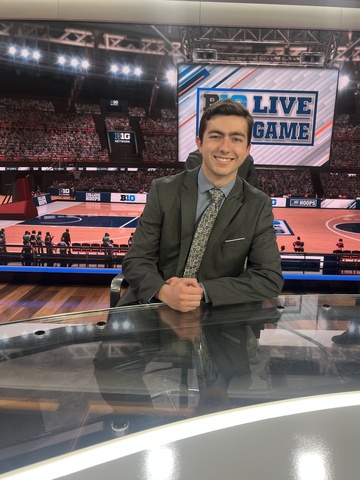
“...the basis of the profile was to weave his life experiences into the game that was happening live, and so it was cool that I was able to do that,” he said.
In the process of crafting this story, Fox shadowed Shaver and had the opportunity to sit with him to see what goes into live play-by-play reporting. He reported that this class also taught him how to brand himself, ask “the right questions” during interviews, and properly conduct research before conversing with sources.
Building on Fox’s point, Peterson stated this course taught him to be mindful and open to new experiences. After all, although he was initially uncertain of how this course would help him further his career goals, he gained valuable experience networking and learning how to brand himself.
Finally, in the process of actually reporting on the teams and creating media, each source noted a set of key journalistic practices they follow when covering sports, specifically. Drehs said in this context, he tries to instill in students a standard of professionalism and neutralism; that is, even if they are big fans of the people they are covering.
Building on Dreh’s statement, Fox acknowledged the importance of keeping interview questions simple and straightforward. This is for two reasons: To facilitate understanding and to respect athletes’/organizations’ time.
Particularly for Fox, this experience brought him one step closer to his career goal of establishing himself in the world of broadcasting.
“I have to recommend the class to anyone that has the opportunity to take it,” he said. “…just the sports market in general, it’s super beneficial because even if you’re not in the journalism realm, it helps so much because of those networking practices, interviewing practices as well.”
Drehs noted that a major benefit of taking this course is also the fact that it allows students to “get out of a classroom and into the real world” to build relationships with key decision makers in the field.
“I think the experience of being at a game…and having to be on the fly and figure it out...doing real-world reporting, I think it is incredibly valuable as well,” he said.
To get involved with this opportunity in the future, students can enroll in the course via schedule builder—although spots fill up fast. For more information about the experience and what it has to offer, students may also reach out to Professor Drehs at wayne-drehs@uiowa.edu.