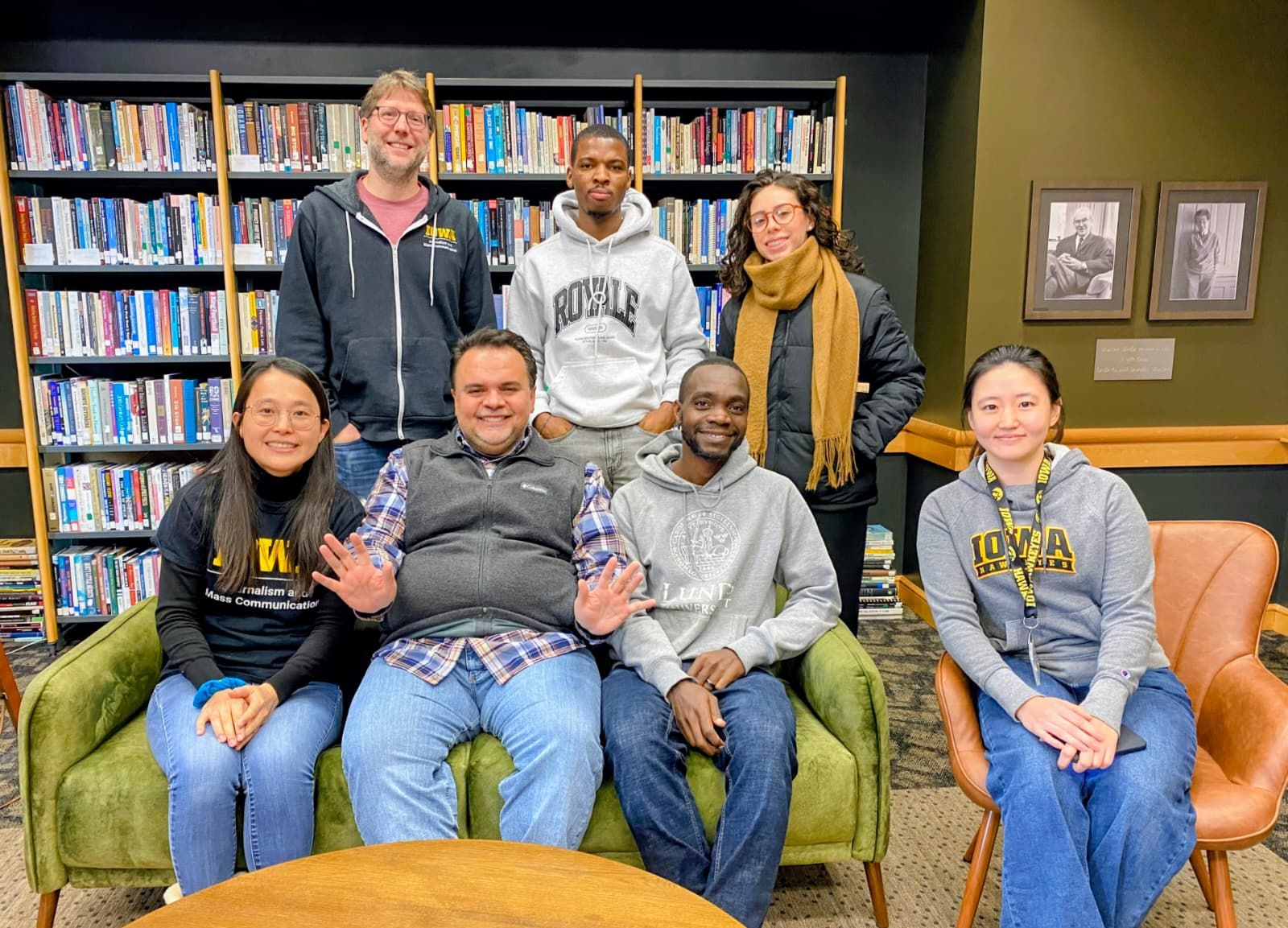
Dr. Jamil Marques, a professor of journalism and political communication at the University of Iowa, has officially revived the Global Media Studies Working Group.
Previously led by current SJMC Chair Melissa Tully, this stellar research opportunity had been dormant for more than two years until Dr. Marques expressed interest in bringing it back.
“I had a conversation with her and Professor Brian Ekdale [about this group], and they suggested me to maybe reactivate it,” he said. “The group is alive again, and I’m very happy about that.”
Having completed his schooling in his home country of Brazil, Dr. Marques has always been interested in how media systems work in different countries. After having the group approved by the Obermann Center for Advanced Studies, Dr. Marques offered the opportunity to four students with the hope of including more in the future.
“Our main intention is to develop studies on several areas concerning comparative media studies...such as comparing media systems and how media regulations work in different countries,” Dr. Marques said.
The Obermann Center supports varying working groups every year, with focuses ranging from the evolution of cognition to comparative global heritage cultures. Dr. Marques’ group, “...seeks to enhance our understanding of both enduring and emerging challenges in global media research,” according to the 2025-26 Working Groups listing.
With a special focus on the intersection of technology, epistemology, and globalization, Dr. Marques and his students hope to better understand inequities in knowledge production and how global media governance shapes policymaking.
Professors, graduate students, and undergraduate students are allowed to participate, but Dr. Marques places a special emphasis on undergrads due to them not having as many opportunities to conduct research in an academic setting.
“I think that they should have the opportunity to at least know what kind of new knowledge and skills they could acquire if they would have the opportunity to be a part of the research world,” Dr. Marques said, citing how in Brazil, undergraduate research is encouraged and has helped students blossom.
The program is still being developed, with Dr. Marques wanting it to be a challenging but low-stress experience. In graduate working groups, students typically critique existing articles and discuss the ideas, methods, and contradictions in the authors’ work. That process will be implemented in the Global Media Studies group, but at a slower pace than in a graduate setting.
“We should have our students, in my opinion, be given a gentler introduction to the research world,” Dr. Marques said. “What I’m trying to do with this small group of students is explain to them how research works very calmly and patiently.”
The four participating students are currently enrolled in Dr. Marques’ Media and Marketing Research course, including SJMC Peer Mentor Grace Escritt. Through classroom research, these students will hone their skills to tackle harder research articles in the spring semester.
“My intention is that, by Spring 2026, this working group will be something students can manage in terms of what they will read and if they understand what is being said,” Dr. Marques said. He also plans to teach them about how to evaluate methodological, framework, and theoretical flaws in written research.
Ultimately, another goal is for these students to better understand the advantages and disadvantages within different global media systems. Dr. Marques explains that the U.S. has an amazing structure for producing academic knowledge, something that many other countries lack due to economic and/or political problems.
Dr. Marques’ approach emphasizes students developing their own perspectives on media research, rather than repeating his opinions. He noted that journalism students are sometimes expected to work in newsrooms or organizations, leading to many being unaware of potential research careers.
“I think they (students) should consider their intellectual growth as an opportunity, as it would be very, very important to developing other sets of skills, such as how to do research, how to manage a survey, and how to gather and process data, which would all be very relevant to their professional careers,” Dr. Marques said.
The Global Media Studies Working Group is currently open to accepting other undergraduate journalism students. Although it is still being developed, students are welcome to contact Dr. Marques at jamil-marques@uiowa.edu about potentially joining and honing their talents.